
Across federal, state, and local agencies, grant funding plays a critical role in driving public impact. From housing support programs to transportation modernization, clean energy adoption to public health interventions, and education improvement to community development, grant funding is often the lifeline that enables public organizations to act on their mandates. In the United States alone, more than half a trillion dollars in federal grants are distributed annually across hundreds of thousands of awards to state and local governments, tribes, nonprofit organizations, and institutions, accounting for roughly 4–5% of U.S. GDP and constituting one of the largest mechanisms for intergovernmental aid and public program delivery.
Yet, despite the vast scale of investment, a significant portion of federal grant programs lack robust measures of performance: evaluations by the Office of Management and Budget have found that nearly half of assessed grant programs do not demonstrate measurable results, highlighting a persistent gap in understanding not just where the money went, but what difference it made.
Several converging forces are fuelling this challenge and reshaping the way public agencies approach grants management. These are:
For decades, grant reporting has been oriented primarily around compliance. Agencies were asked to demonstrate that funds were spent and allocated properly, recipients were eligible, procurement guidelines were followed, and documentation was retained. While compliance is essential, it does not fully answer the questions that public agencies are increasingly being asked today:
These questions require insight into performance, not just spending. This shift cannot be achieved through traditional and static spreadsheets and manual narrative reports. It requires data integration, analytics maturity, and decision intelligence. This is where Grant Performance Analytics enters the picture.
Grant performance analytics refers to the systematic use of data to measure how effectively a grant is being managed, how funds are being used, and what outcomes or results the grant is delivering. It is a disciplined application of integrated data, advanced analytics, and performance measurement to understand how well a grant is functioning – financially, operationally, and in terms of measurable real-world impact. It provides answers to questions such as:
These insights elevate the role of data from record-keeping to actionable decision-making. This doesn’t just improve day-to-day program delivery but also supports better policy decisions, faster adjustments, and stronger outcomes for communities. With a clear view of spending, performance, and results, agencies can strengthen program integrity, improve beneficiary outcomes, optimize resources use, and build confidence with oversight bodies and the public. Most importantly, this allows agencies to tell the full story – not just how funds were spent, but how those funds made a tangible difference in people’s lives.
Delivering performance-driven grant management requires more than simply tracking reports or expenditures. Agencies need a consistent and structured way to connect funding decisions with real outcomes – to see not just how money was spent, but what actually changed because of it. This means moving past siloed systems, scattered metrics, and after-the-fact reporting. Instead, agencies need a strong analytics foundation that brings together the right data, clear performance indicators, and timely insights for everyone involved in managing a grant. This creates a complete, real-time view of performance and helps agencies make better, faster, and more accountable and transparent decisions.
To make this possible, a modern Grant Performance Analytics framework must be built on five essential capabilities:
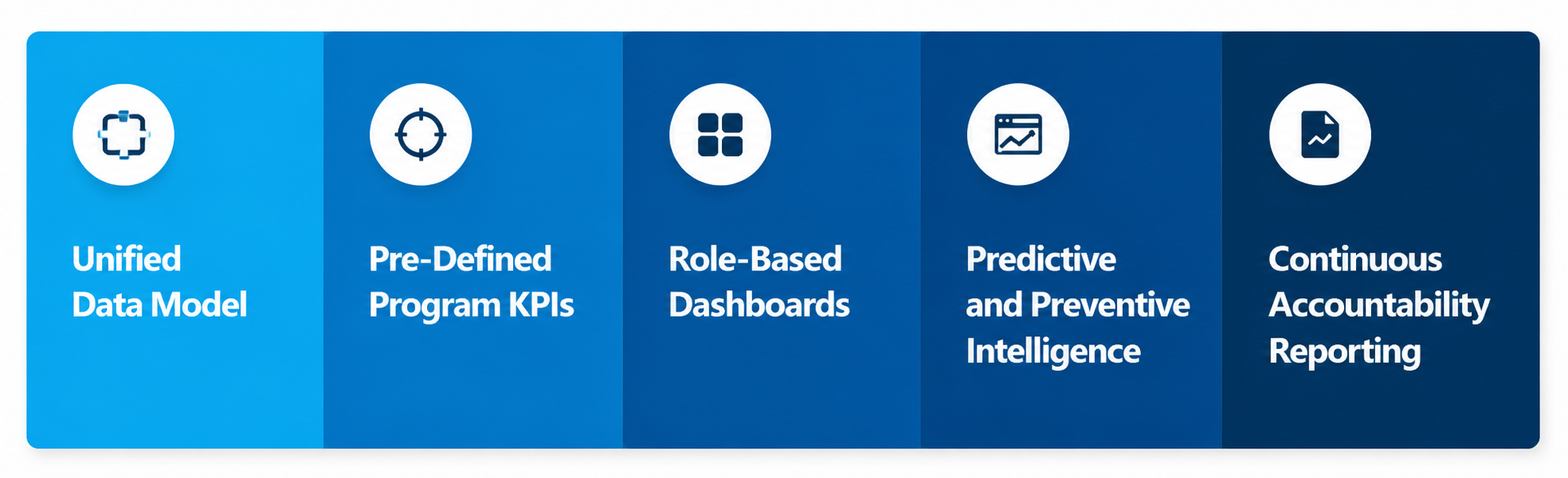
Together, these capabilities shift oversight from reactive (discovering issues after the fact) to proactive (preventing issues before they harm outcomes). Instead of learning about problems too late, agencies gain a forward-looking radar that helps them keep programs on track, improve service delivery, and protect public dollars.
Public agencies increasingly recognize the need for strong, data-driven grant performance management but the path to achieving this is often not straightforward. For years, many organizations have pursued custom-built analytics systems, crafted from the ground up to match unique program structures, funding models, and reporting demands. While these solutions can be highly tailored, they also require significant investment. Long implementation cycles, complex data integration work, iterative KPI development, and ongoing support from specialized analytics staff make custom builds difficult to sustain, especially for agencies already challenged by limited staff capacity, tight budgets, and urgent compliance deadlines. In many cases, by the time a custom solution is fully deployed, needs, policies, or funding requirements may have already shifted.
These realities are pushing agencies toward a more pragmatic, faster, and cost-effective model: ready-to-use, configurable analytics platforms specifically built for grants. These platforms offer a strong foundation from day one – including pre-defined data models aligned to federal and state grant structures, standardized KPIs reflecting widely adopted performance frameworks, and role-based dashboards for finance, program delivery, field operations, and executive oversight. Because the core components are already built, agencies can quickly connect their data and begin generating insights immediately, without the long ramp-up associated with custom solutions.
Modern platforms also embed features such as automated data quality checks, built-in compliance indicators, and increasingly, GenAI-powered insights that generate narrative explanations, performance summaries, and actionable trend interpretations. The result is faster time-to-value, lower implementation risk, and the ability for agencies to focus less on building the analytics infrastructure and more on using insights to improve grant performance and deliver meaningful community outcomes.
DiLytics Grant Insight Solution is a ready-to-use, GenAI-powered grant performance analytics platform that unifies financial, operational, and program data to give agencies a complete, real-time view of how their grants are performing. Instead of piecing together spreadsheets or navigating multiple systems, agencies get a connected, drillable, and analytics-ready environment that answers the key question: Are our grant dollars delivering the outcomes we promised?
A high-level architecture of DiLytics Grant Insight Solution is provided below:
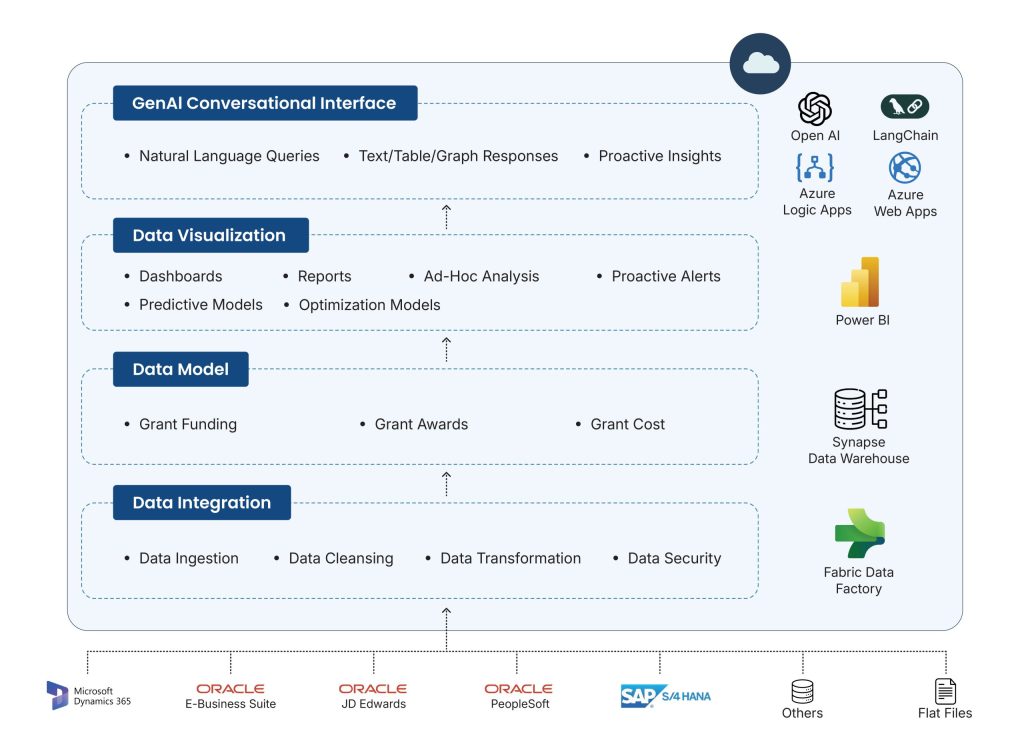
The solution provides full transparency into both grant financial management and grant performance, enabling agencies to track how funds are approved, committed, spent, and translated into measurable results. It offers clear visibility into Awards Approved, Pending, and Posted Amounts across Budgets, Encumbrances, and Actuals, while also linking financial discipline to program execution, outputs, and outcomes. Users can analyze raw and burdened costs at the account, project, and task levels to understand not only where funds are flowing, but also how effectively they are being used to achieve program objectives.
Each subject area in the solution is designed to answer a different part of the performance story:
With GenAI embedded throughout, DiLytics Grant Insight Solution automatically produces narrative insights, risk flags, KPI summaries, and plain-language explanations that help leadership, program directors, and field teams understand what’s happening and why.
With this solution, agencies gain more than dashboards – they gain the ability to connect dollars to outcomes, communicate impact with clarity, and move from reactive reporting to proactive performance management. The result is a grant environment where:
For a real-life case study about how DiLytics Grant Insight Solution enabled Los Angeles County Sanitation Districts enhance both efficiency and community impact of their grant funded programs, read here.
Public trust grows when agencies can clearly and confidently explain how grant money was used, who benefited, what impact was created, and what should happen next. Grant Performance Analytics helps make this possible. It doesn’t just improve day-to-day program delivery; it also supports better policy decisions, faster adjustments, and stronger outcomes for communities. With a clear view of spending, performance, and results, agencies can strengthen program integrity, improve beneficiary outcomes, optimize resources use, and build confidence with oversight bodies and the public. Most importantly, it allows agencies to tell the complete story – not just how funds were spent, but how those funds made a real difference in people’s lives.
DiLytics helps organizations modernize analytics, improve decision-making, and turn complex data into a competitive advantage.