With all these changes, the supply chain function in pharmaceutical and life sciences companies currently faces the following pressing challenges:

The pharmaceutical and life sciences supply chain has undergone enormous changes over the last couple of centuries. And with each change, the extent of complexity has increasingly become more.
In the 19th century, the supply chain was very localized – products were manufactured and consumed in a very small geographical area. In the beginning of the 20th century, globalization and advancements in transportation and storage allowed companies to distribute products over a much larger geographical area. With this change came new challenges such as longer lead times, increased risk of delays, and greater exposure to geopolitical disruptions. Today, pharmaceutical supply chain visibility is increasingly important as companies manage complex global networks, regulatory requirements, and changing demand patterns.
In the mid-20th century, agencies like the U.S. Food and Drug Administration and the European Medicines Agency brought sharp focus on regulatory compliance and quality control. As a result, Good Manufacturing Practices and Good Distribution Practices were established, which brought in increased transparency and control over the movement of products. This added complexity and cost to the supply chain, as companies had to make investments in infrastructure upgrades to meet regulatory compliance.
In more recent times, outsourcing and offshoring of manufacturing to low-cost countries in the Asian region has introduced increased lead times, more dependency on external suppliers, and higher exposure to geopolitical tensions. Additionally, disruptions such as natural disasters, pandemics, or port delays in supplier regions now have a more pronounced ripple effect across a globalized supply chain.
With all these changes, the supply chain function in pharmaceutical and life sciences companies currently faces the following pressing challenges:
Amidst this scenario, the ability to track, monitor, and analyze data throughout the supply chain–from supplying raw materials to manufacturing, distribution, and final delivery to hospitals, pharmacies, or patients–has become a key need for pharmaceutical and life sciences companies to tackle these challenges. This ability, called ‘Supply Chain Visibility,’ helps companies get a real-time, end-to-end view of their supply chain network. Supply chain visibility analytics brings together data from different stages of the network to help organizations identify risks, monitor performance, and respond more effectively to supply and demand changes.
In this blog, we will discuss the role of data analytics in providing pharmaceutical supply chain visibility and supporting more effective Pharma Supply Chain Analytics for pharmaceutical and life sciences companies.
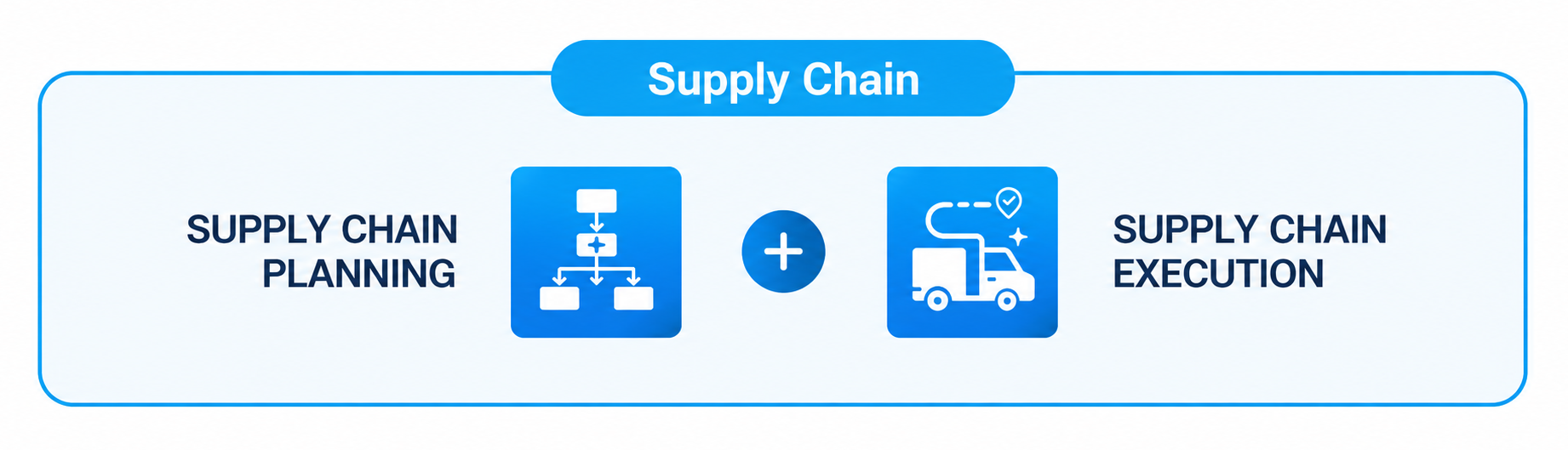
The supply chain ecosystem can broadly be divided into two interdependent yet distinct segments: The first segment is ‘supply chain planning,’ which deals with identifying the actions that need to be taken to establish an efficient and effective supply chain. The second segment is ‘supply chain execution’ which deals with actual execution of the steps identified during ‘supply chain planning’ stage. For pharmaceutical organizations, supply chain planning analytics helps connect demand, supply, inventory, production, and logistics data to support better planning decisions.
This blog is in a two-part series. In this (1st part) part, we’ll explore the role of data analytics in driving visibility in ‘supply chain planning’ segment. In the next blog, we’ll focus on how data analytics drives visibility across ‘supply chain execution’ segment.
Several technology solutions are crucial for enabling robust supply chain visibility in the pharmaceutical and life sciences industry. These technologies work in concert to provide real-time data, enhance decision-making, and improve overall supply chain performance. The top five technology solutions include:
Among the above-mentioned technologies, data analytics acts as the intelligence layer–interpreting signals from IoT devices, identifying patterns across cloud supply chain management platforms, informing AI models, and validating blockchain records. In doing so, it augments supply chain visibility by acting as the backbone that integrates data from various sources and provides a single source of truth across the entire supply chain.
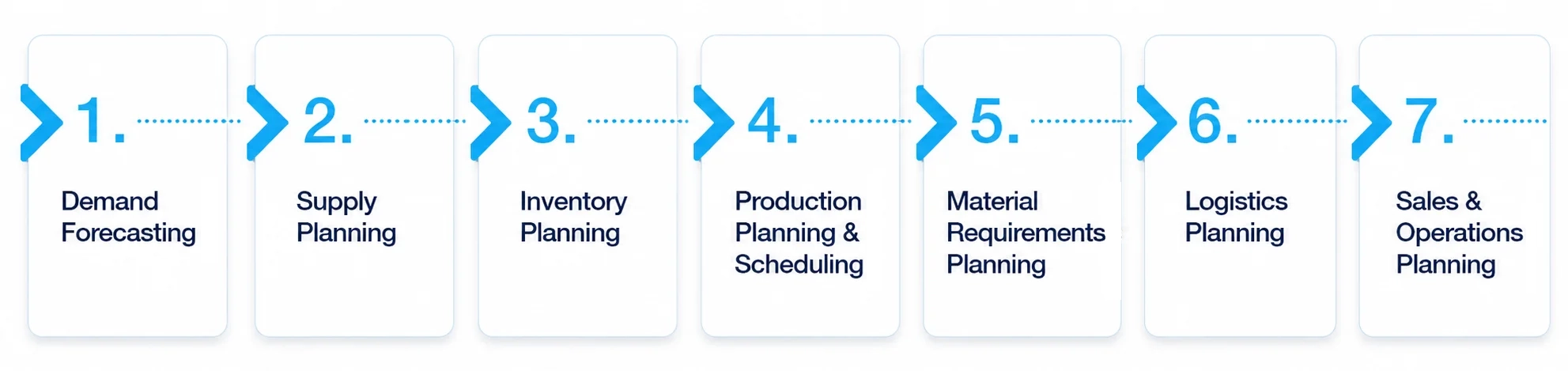
Supply chain planning focuses on the following areas:
Pharmaceutical demand forecasting is the process of understanding and predicting customer requirements for pharmaceutical products. This involves analyzing historical sales data, market trends, seasonality, promotional activities, and other relevant factors to estimate future demand. Accurate demand forecasting is crucial for ensuring that the right amount of product is available at the right time, minimizing stockouts and excess inventory. When combined with supply chain planning analytics, demand forecasts can help organizations align production, procurement, inventory, and distribution decisions more effectively.
However, most companies lack a unified view of data due to information residing in disparate systems – sales and order data in CRM systems, prescription and dispensing data in 3rd party data providers, inventory, production and procurement data from ERP, clinical trial data from clinical trial management system, etc. Further, the data used for forecasting is generally not of good quality and is not available at a lower level of granularity e.g. at SKU-level, for specific regions or individual pharmacies.
This leads to challenges such as stockouts and product shortages, overstocking and waste, suboptimal production planning, inaccurate budgeting, lost sales and market share and regulatory compliance risks.
This is where data analytics technology can play an important role in ways such as:
Pharmaceutical supply chain planning involves identifying the most optimal suppliers for raw materials, active pharmaceutical ingredients, packaging materials, etc.; evaluating their capabilities; negotiating contracts with them; and managing relationships with them. Supply chain planning analytics can help organizations combine supplier, demand, inventory, and operational data to make more informed sourcing and supply decisions.
Most pharmaceutical and life sciences companies suffer from unavailability of real-time visibility into supplier capabilities and performance. This leads to increased risk of disruption, shortages, sub-optimal product quality, inefficient inventory management and reduced responsiveness.
Data analytics can play a significant role in addressing these gaps by:
Pharmaceutical inventory management is about determining the optimum requirement of stock of raw materials, work-in-progress, and finished goods to meet demand as per the demand forecast. This planning draws the fine balance between the opportunity cost of stockout and excess inventory holding cost (storage, obsolescence, and insurance).
Most pharmaceutical and life sciences companies face inventory planning challenges due to a variety of factors such as lack of availability of integrated data, inaccurate demand forecasting, limited real-time tracking of goods at various stages of the supply chain, inefficient management of suppliers, unoptimized warehouse operations, and inadequate risk planning. Supply chain visibility analytics can help planners monitor inventory positions across locations, identify potential shortages or excess stock, and improve inventory decisions.
Data analytics can address these challenges by:
Production planning deals with ascertaining what to produce, how much to produce, when to produce, and how to produce. All this is done in alignment with demand forecast and available resources. For pharmaceutical manufacturers, supply chain planning analytics can connect demand forecasts with production capacity, inventory levels, material availability, and resource constraints to support more effective production planning.
In many pharmaceutical and life sciences companies, the various source system such as ERP, Manufacturing Execution System, Laboratory Information Management System are not integrated. Due to this, companies conduct manual calculations and spreadsheet-based production planning and scheduling. This results in challenges such as high production cost, high inventory cost, inefficient utilization of resources, slow responsiveness to demand changes, frequent stockout, high number of backorders, etc.
Data analytics can help companies overcome these challenges by:
Material Requirement Planning (MRP) is the process of determining what materials are needed, how much of them are needed, when are they needed and where are they needed for manufacturing the final product. The main objective of MRP is to ensure that raw material is available for production in a timely manner without increasing the inventory carrying costs.
Many pharmaceutical and life sciences companies, especially the small and medium sized ones, resort to manual processes and usage of spreadsheets for MRP. Often data from different systems – Laboratory Information Management System, Manufacturing Execution System, Inventory Management System – does not come to MRP system due to lack of integration. Also, planners resort to manual overrides due to lack of trust in system-generated recommendations. These leads to challenges such as production delays, re-scheduling of production runs, reduced throughput, wasted labor and inefficient use of equipment.
Data analytics can help organizations alleviate these challenges by:
Logistics planning deals with managing the movement, storage, and flow of materials and finished goods across the supply chain. This includes: 1) Inbound logistics – planning transportation and storage of raw materials and components from suppliers to manufacturing sites; 2) Internal logistics – coordinating movement between manufacturing, packaging, and warehousing units; 3) Outbound logistics – managing delivery of finished products to wholesalers, hospitals, pharmacies, and patients.
Many pharmaceutical and life sciences companies operate with fragmented IT systems for different logistics functions. Also, planning tasks related to route optimization, carrier selection and delivery schedules are often handled manually or with static rules. This leads to challenges such as stockouts at distribution points (pharmacies, hospitals, and distributors), increased product recalls due to compromised quality, high logistics costs, lost revenue from returned/wasted/ expired products, fines and penalties for regulatory violations.
Data analytics can address these challenges by:
Sales and Operations Planning (S&OP) aligns demand forecasts, supply capabilities, inventory levels, and financial goals to ensure that a company can meet customer demand efficiently while optimizing inventory, resources, and costs. For pharmaceutical and life sciences organizations, supply chain planning analytics provides the data-driven foundation needed to evaluate demand, supply constraints, inventory, production capacity, and potential scenarios as part of the S&OP process.
Most pharmaceutical and life sciences companies’ systems landscape is fragmented – CRM for sales, ERP for finance, MES for production, LIMS for quality. Further, many rely heavily on manual processes and spreadsheets which limits their ability to do scenario planning and real-time adjustments. This leads to high inventory costs, inefficient capacity utilization, increased production and logistics costs, missed market opportunities, delayed and ineffective new product introduction and unreliable delivery.
Data analytics can address these challenged by:
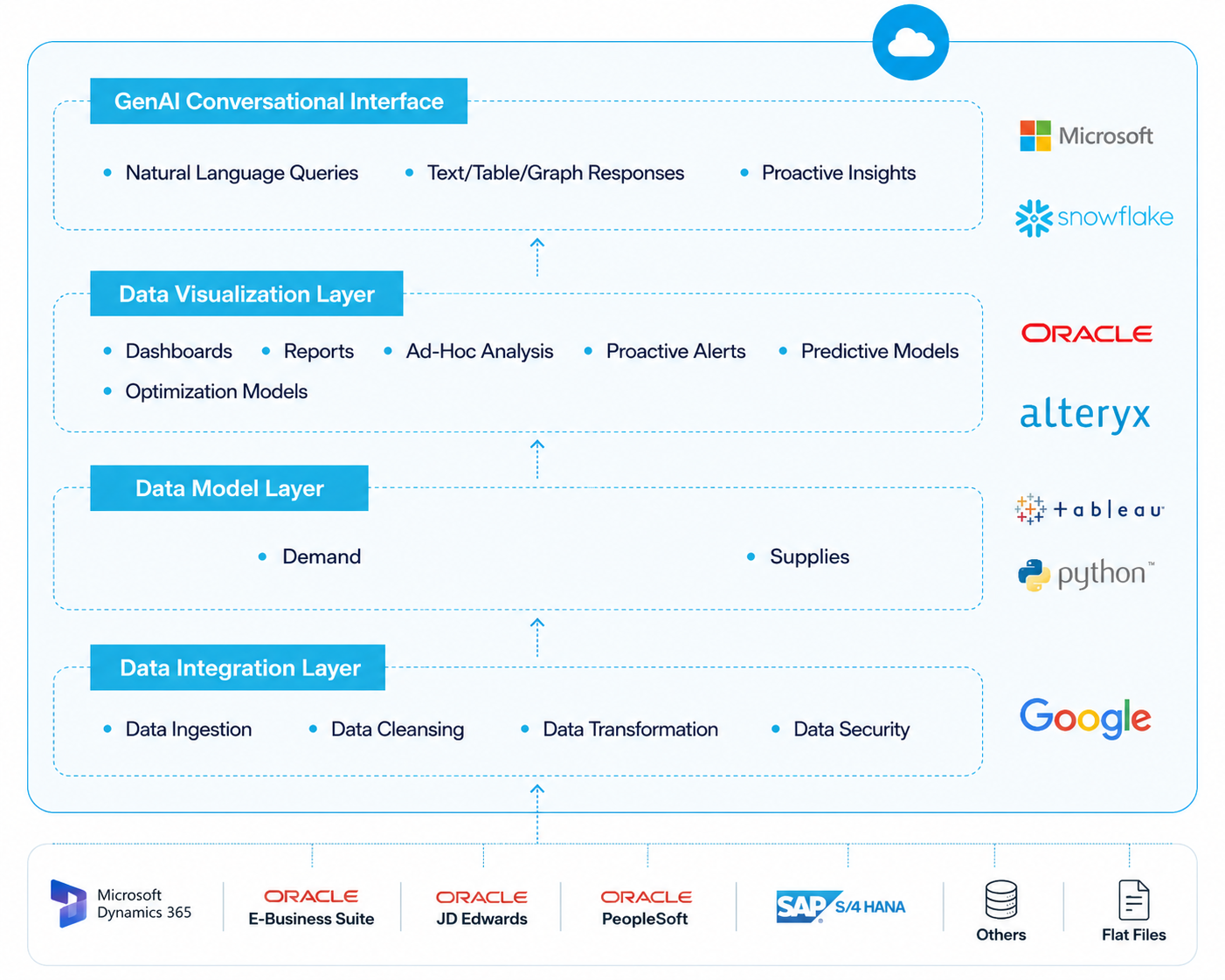
DiLytics has built a supply chain planning solution, branded as DiLytics Supply Chain Planning Insight Solution, that provides the above-mentioned functionalities/capabilities for the pharmaceutical and life sciences industry. This solution comes with:
A high-level architecture of DiLytics Supply Chain Planning Insight Solution is provided below:
In the pharmaceutical and life sciences industry, where strict regulation, supply disruptions, and demand volatility are common, data analytics provides a potent mechanism to obtain end-to-end supply chain visibility. By breaking down data silos and leveraging advanced analytical techniques, companies can move from reacting to problems to predicting and preventing them. Leveraging these capabilities will empower companies to manage volatility better, minimize risks, reduce costs, and build a resilient supply chain. The future of the supply chain is data-driven, and visibility is at its core.
DiLytics helps organizations modernize analytics, improve decision-making, and turn complex data into a competitive advantage.