Building an Effective Analytics Strategy and Roadmap

November 3, 2022

Sudhir Varma

Business Analytics

It is said that leadership is like moving ahead with a ‘compass’ and a ‘clock’ – the compass tells if the direction is right and the clock tells how much time it will take to reach the destination.

The veracity of the above statement can be observed in the case of companies that recognize analytics as an integral constituent of their leadership ambition. For such companies, the ‘destination’ is ‘to become data-driven’; and to reach this destination, analytics strategy is the compass and the roadmap is the clock. A well-defined data analytics strategy helps organizations align their analytics investments with business priorities and build toward enterprise analytics capabilities. 

Having understood that an analytics strategy roadmap is an important navigational tool for companies seeking analytics leadership, let us understand what analytics strategy and roadmap are.

What is Analytics Strategy and Roadmap?

Analytics strategy is a company’s intent that specifies the people, process, and technology aspects that it should put in place to ensure that the right insights reach the right people at the right time to make the right decisions. A strong business analytics strategy aligns analytics initiatives with organizational goals, while a data analytics strategy establishes how data, technology, talent, and governance should support those goals.

An analytics roadmap is the translation of an analytics strategy’s intent into a plan of action that identifies the various initiatives that a company needs to undertake, evaluates the potential of each initiative, and outlines how and when they should be undertaken. Together, the strategy and roadmap provide an analytics strategy framework for prioritizing initiatives and building scalable analytics capabilities. 

Why is Analytics Strategy and Roadmap Important?

It is important for companies to embark on the analytics strategy and roadmap exercise as it enables them to channelize the power of analytics toward the achievement of their business goals. Such an exercise provides a definitive goal and direction to a company’s efforts and investments in analytics, from business intelligence strategy and KPI reporting to data platforms and advanced analytics.

For organizations pursuing enterprise business intelligence, a clearly defined strategy helps ensure that investments in data, reporting, and analytics are aligned with business priorities rather than being driven by isolated departmental requirements. Its absence leads to a state best described by the famous quote from Lewis Carroll: “If you don’t know where you want to go, any road will get you there.”

Further, it is imperative that the ‘analytics strategy and roadmap’ exercise is kept focused on the necessary elements only so that the exercise is conducted economically, in quick time, and justifies the cost-benefit equation. 

How to Embark on 'Analytics Strategy and Roadmap' Exercise?

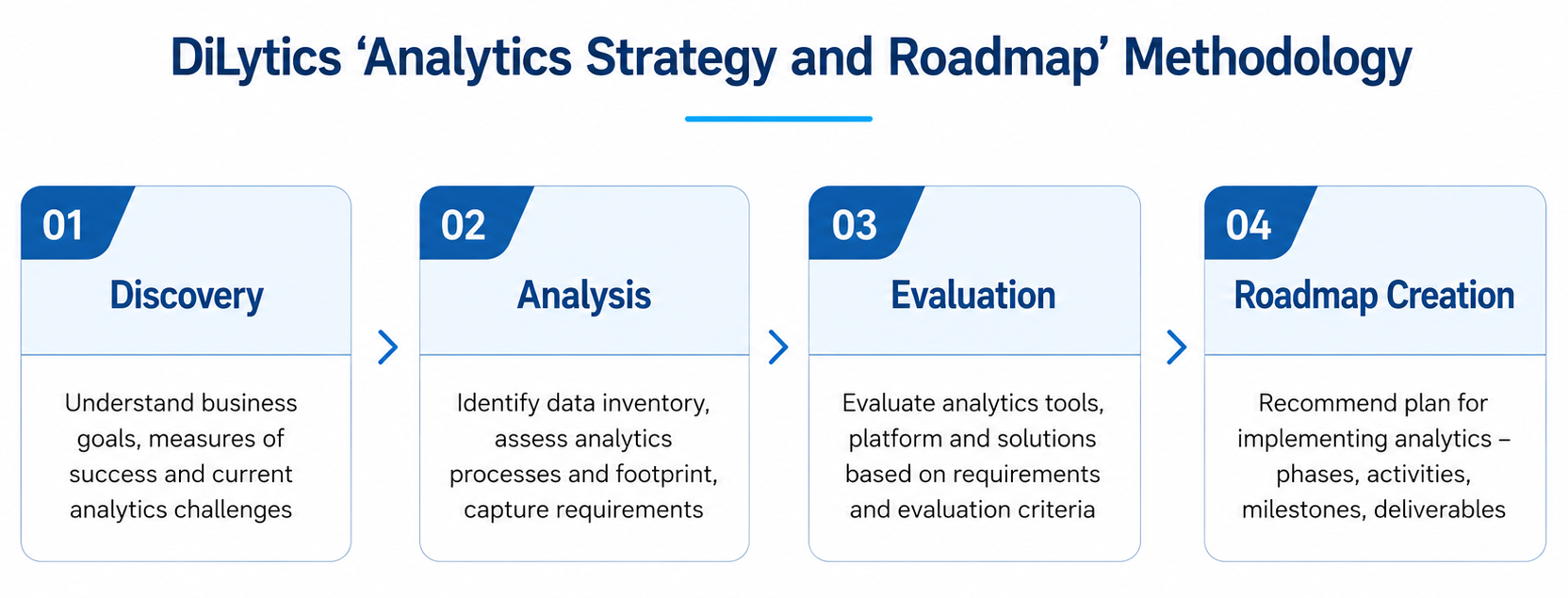
Depicted below is the structured four-phase analytics strategy framework that DiLytics follows in carrying out an ‘Analytics Strategy and Roadmap’ exercise for customers.

DiLytics is of the firm conviction that an analytics strategy roadmap exercise should be carried out in a structured and focused manner so that pertinent recommendations are arrived at and shared with customers quickly. In DiLytics’ experience, this exercise has been conducted in a matter of a few weeks. The DiLytics methodology is designed to help organizations assess their current analytics capabilities, identify priorities, and define a practical path toward enterprise analytics. The different phases in the DiLytics methodology are described in more detail below: 

1. Discovery

Key activities carried out in this phase are:

  • Understand the client’s strategic business goals and specific measures of success.
  • Validate scope w.r.t objects to be analyzed, KPIs and Metrics of interest, Reports and Dashboards, Data Warehouse, Data Sourcing, and Integration, Data and Object Security need.
  • Identify key stakeholders from the client’s business and IT teams.
  • Conduct interviews at executive and department levels to understand the challenges faced and gain knowledge of what the client is trying to accomplish.

2. Analysis

Key activities carried out in this phase are:

  • Identify data sources; how data is gathered, where it exists, roadblocks in accessing it.
  • Know the client’s organizational structure; people skills; staff augmentation and training needs.
  • Identify high-level business processes and the data needed to support them; how is data utilized in decision making.
  • Assess the current platform utilized for data warehouse, data integration, and reporting; the extent to which the current operating system support analytics needs.
  • Document findings and recommendations and share them with the client.
  • Capture high-level functional and technical requirements; review them with the client.

3. Evaluation

Key activities carried out in this phase are:

  • Prepare product evaluation criteria based on the multiple specifications including functional, technical, business, and cost.
  • Assign weightages to evaluation criteria.
  • Finalize the products to be evaluated – data warehouse, data integration, and reporting.
  • Rate selected products against evaluation criteria.
  • Provide product recommendations based on prioritized requirements and evaluation criteria.

4. Roadmap Creation

Key activities carried out in this phase are:

  • Develop an implementation phasing strategy based on considerations such as the business objective, the criticality of requirements, ease of implementation, and dependency.
  • For each phase, identify the activities, milestones, and deliverables.
  • Estimate high-level timelines to implement each phase.
  • Define talent and training needs for each phase of the implementation.

Conclusion

An analytics strategy and roadmap exercise is the foundation that every company should lay for guiding its various analytics initiatives toward successful completion. A well-defined business analytics strategy helps organizations align business priorities, data, technology, and talent, while an actionable roadmap provides a clear path for implementation.

When viewed objectively, it is a small investment both in terms of money as well as time, which pays off manifold by streamlining the execution path of other larger-dollar-value analytics programs in a company. It can also provide the foundation for an effective business intelligence strategy, scalable enterprise analytics, and a coordinated data integration strategy.

DiLytics has extensive experience in helping companies determine the strategic direction for their analytics initiatives. For any queries related to this topic, please reach out to us at [email protected].

Data-Driven Organizations Are 3x More Likely to Achieve Better Business Outcomes

DiLytics helps organizations modernize analytics, improve decision-making, and turn complex data into a competitive advantage.