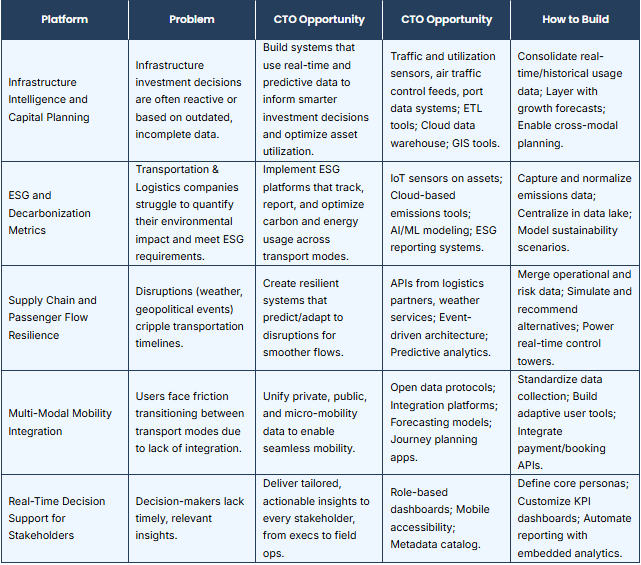
5 Strategic Areas Where CTOs Can Expand Analytics Impact
To maximize the value of analytics, CTOs should focus on strategic initiatives that improve operational efficiency, strengthen decision-making, and support long-term business growth. The following areas offer the greatest opportunity to drive measurable impact:
1. Infrastructure Intelligence and Capital Planning
Problem: Infrastructure investment decisions are often reactive or based on outdated, incomplete data.
CTO Opportunity: Build systems that use real-time and predictive data to inform smarter investment decisions and optimize asset utilization.
To achieve this, CTOs can build data infrastructure that brings together real-time and historical usage data from diverse transportation modes. This data can be layered with demographic trends and economic growth forecasts to support investment modeling. A centralized repository supports spatial analysis and long-term planning. Visualization and scenario tools should then be deployed to facilitate cross-modal capital prioritization and track ongoing performance.
2. ESG and Decarbonization Metrics
Problem: Transportation companies struggle to quantify their environmental impact and meet ESG requirements.
CTO Opportunity: Implement data-driven ESG platforms that track, report, and optimize carbon and energy usage across transport modes.
Build a data system that collects emissions and energy data from a variety of transportation modes. This data is then cleansed, standardized and assembled in a centralized platform, where powerful algorithms simulate alternative carbon-reduction strategies. Companies that combine operational and ESG datasets can monitor sustainability KPIs in real time, compare against targets, and dynamically change strategies.
3. End-to-End Supply Chain and Passenger Flow Resilience
Problem: Disruptions like extreme weather or geopolitical events often cripple transportation timelines.
CTO Opportunity: Create resilient systems that predict and adapt to disruptions in real time, ensuring smoother flow of goods and people.
Combine in-house operational data with external risk signals sourced from meteorological, geopolitical, and supplier systems. This necessitates an event-driven architecture that analyzes real-time updates and incorporates them into predictive models. Outputs are presented in operational control towers, allowing stakeholders to take prompt action. Furthermore, automated alarms and decision-support systems improve proactive risk management.
4. Multi-Modal Mobility Integration
Problem: Decision-makers across departments lack access to timely and relevant insights.
CTO Opportunity: Deliver tailored, actionable insights to every stakeholder, from executives to field operators.
The idea here is role-based data access and customized analytics interfaces. CTOs should define stakeholder personas and align data outputs to their specific KPIs. Dashboards and alerts can then be designed to surface timely, relevant insights. Embedding these tools into daily workflows, whether through mobile apps, portals, or integrations, ensures that every role has decision support where and when it’s needed.
5. Real-Time Decision Support for Stakeholders
Problem: Users often face friction when transitioning between different transport modes due to lack of integration.
CTO Opportunity: Develop platforms that unify private, public, and micro-mobility data to deliver seamless mobility experiences.
CTOs should develop an integration layer that standardizes mobility data across providers. This includes synchronizing schedules, occupancy, and availability. Once unified, this data can feed journey planning tools and support dynamic demand forecasting. A consumer-facing application can leverage real-time updates to optimize travel routes and costs, while backend systems manage pricing, booking, and service coordination.